


While riding the subway today, I received a very pleasant surprise.
The subway operator was the famous, viral “Uncle Crawfy” (aka Alex Crawford)! Instead of the usual matter-of-fact announcements that stated the obvious (Lansdowne station…Landsdownnnnnnne), Uncle Crawfy shared local trivia, chatted up the crowd, and introduced us to his “co-pilot” Sebastian.
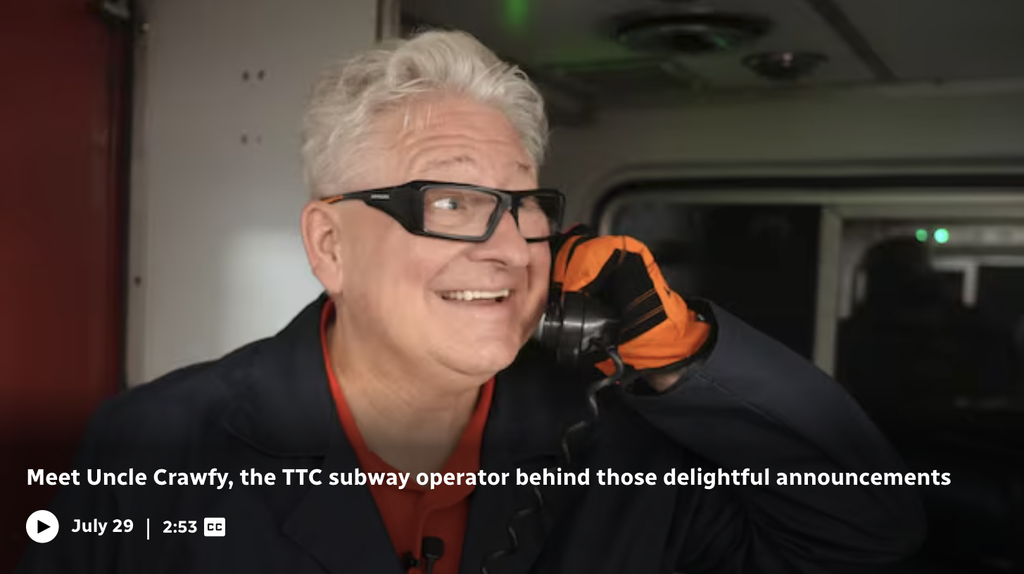
Photo Courtesy of cbc.ca
At one point, he started greeting subway riders in different languages. He even threw in an “aloha” and a pretty decent anyeonghaseyo!
I can’t wait to catch his haiku Thursdays.
My point is this: Alex’s job is to be a subway operator. He needs to drive safely, and get riders on board and off board safely. That’s his job. That’s what he’s trained to do and that’s what he gets paid to do.
But he’s a subway operator “plus.”
Alex uses his skills in improv and open mics to make the silent subway ride (full of weary, reserved Torontonians) a bit more charming and a bit more fun. It felt like a serendipitous journey through the lens of a warm-hearted soul.
“Now I don’t know what the technical term for this is, but what you’re looking at…is a beautiful day…and it’s all yours.” This is a classic Crawfyism.
What about you? Do you ever get stuck in the mindset that “doctors can only practice medicine?” Full stop.
Is that what you think?
I understand if you think that.
After all, you spent years getting trained to be a doctor. You had/have a huge amount of student debt. And there are lots of Canadians without access to timely care. It only makes sense that you stay in your lane and work a lot and pay back your student loans and be there for your patients and and and…
While I do agree that perhaps there isn’t the biggest non-medical market for very niche medical specialties (like, if you’re an ENT surgeon but only focus on…noses…or you only see patients with a rare autoimmune disease that people can’t even pronounce correctly), you’ve shown that you can work hard, learn staggering amounts of challenging material, and navigate increasing patient expectations with fewer resources.
But going through the fire that is medical training teaches you so much more.
You’re probably kind.
You can read the hidden agenda behind subtle body language.
You can recognize the fading patterns of abuse on your patient’s skin.
You’re proficient with life-saving procedures.
You’re good at condensing rambling histories that start with “doctor, when I was 12 years old…” into crisp prose.
You’re efficient.
You’re a beast at learning.
You recognize patterns.
You’re used to thinking of someone else first and putting their needs before your first pee break.
Plus, you have whatever made you the fabulous person you were before you got into medicine.
Do you need to write haikus to your patients or tell them where to get the best local beef patties?
Well…
Why not?
All I’m saying is that your worth as a doctor is not only measured by the hours you practice at the bedside.
If you like this post, would you consider sharing it with someone who needs to hear the message?
